What is Science?
The goal of science is to investigate and understand nature, to explain events in nature, and to use those explanations to make useful predictions. Scientists do this numerous amounts of ways duch as conducting experiments, creating theories, and collecting data.
The Scientific Method
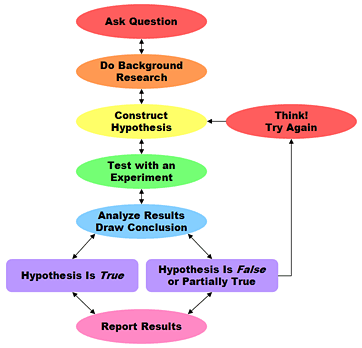
The scientific method is a list of the common steps that biologists and other scientists use to gather information and answer questions. The basic steps of the scientific method are to first state the problem, form a hypothesis, set up a controlled experiment, record the results, analyze the results, draw conclusions and publish your results or revise the experiment and start over. A hypothesis is an explaination for a question or a problem that can be formally tested. It is one of the most important steps of the scientific method because it sets up a starting point for the experiment. An experiment is an investigation that tests a hypothesis by the process of collecting information under controlled conditions. The conclusion of an experiment is a stated decision that tells whether the results of the experiment support the hypothesis or not. Experiments can lead to the creation of a theory. A theory is an explaination of a natural phenomenon that is supported by a large body of scientific evidence obtained from many different investigations and observations. A theory results from continual verification and refinement of a hypothesis.
Controlled Experiments
A controlled experiment is always kept constant or the same. It is the standard against the results that are being compared and it recieves no experimental treatment. Controlled experiments are most often used in laboratory settings. In an experimental experiment things are changed to test its effect. It recieves experimental treatment unlike in controlled experiments. In a controlled experiment, only one condition is changed at a time. The condition in an experiment that is tested is the independant or manipulated variable, because it is they only factor that affects the outcome of the experiment. While testing the independant variable, scientists oberve or measure a second condition that results from the change. This conditon is the responding or the dependent variable. Any changes in it depend on changes made to the independant variable.
Examples of Controlled Experiments
Four hundred years ago people believed in spontaneous generation, which was the idea that life could appear from nonliving material. The scientists Francesco Redi and Luis Pasteur designed controlled experiments to reject the idea of spontaneous generation. They both used two different experiments that gave two completely different results.
Francesco Redi's Experiment
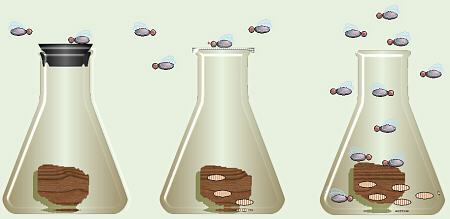
Francesco Redi used a controlled experiment involving flies, meat and covered and uncovered jars. He wanted to show that flies do not spontaneously arise form decaying meat. He began his experiment by putting some meat in each of the two jars. He then covered one of the jars but allowed it to let in air and left the other jar uncovered. After a few days Redi saw maggots on the decaying meat in the open jar, but he saw no maggots on the decaying meat in the covered jar. Redi reasoned that flies had laid eggs on the meat in the opened jar and the eggs hatched into maggots. Because flies could not lay eggs on the meat in the covered jar, there were no maggots there. Redi concluded that decaying meat did not produce maggots. In this experiment Redi controlled the amount of meat in each jar and whether or not the jars were covered.
Luis Pasteur's Experiment
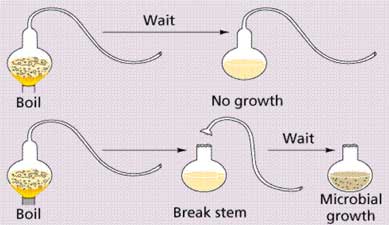
By Louis Pasteur's time controlled experiments were procedure. By carefully controlling whether or not bacteria could enter a flask, Pasteur proved that bacteria only come from exsisting bacteria. He began his experiment by putting clear broth into two flasks with curved necks. The necks would let in oxygen but keep bacteria from the air. Pasteur boiled the broth in one flask to kill any bacteria in the broth. He did not boil the broth in the other flask. In a few days, the unboiled broth became cloudy, showing that new bacteria were growing. The boiled broth remained clear. Pasteaur concluded that bacteria do not spontaneuosly arise from the broth. Newbacteria appeared only when new bacteria were present.
Types of Data
There are two main types of data known as quanitative and qualitative data. Quanitative data is data that you can't touch and is usually in number form. It can be used to make a graph or table. An example of quanitative data is there are five toys. There is no other way to describe how toys there are withought using a number. Quanitative usually answers the question how many. Qualitative data is observational data and it describes things using any of the five senses. An example of qualitative data would be the ball is red. This data is qualitative because the color of the ball can only be known through using one of your five senses.
Common Tools Used By Scientists
The metric system is a measurement system based on the base-ten numeration system and used in most countries around the world.
Most scientists use the metric system when collecting data and doing experiments. They do this because it is a universal way to compare all of the information aquired through measurements. One important goal of the metric system is to have a single unit for any physical quantity. Another important goal is so that there won't be any conversion factors when making calculations with physical quantities.

Scientists use a large variety of miscroscopes to look at what they are examening in greater detail. Thereare two types of miscroscopes that are more commonly used by scientists. They are called light microscopes and electron microscopes. Light microscopes produce magnified images by focusing visible light rays. Electron microscopes produce magnified images by focusing beams of electrons. SEM or scanning electron miscroscopes can scan the surface of the specimen and produce a realistic 3-D image. TEM or transmission electron miscroscopes have the ability to shine a beam of electrons through the specimen to reveal a great amount of detail inside the specimen.


