What is Genetics?
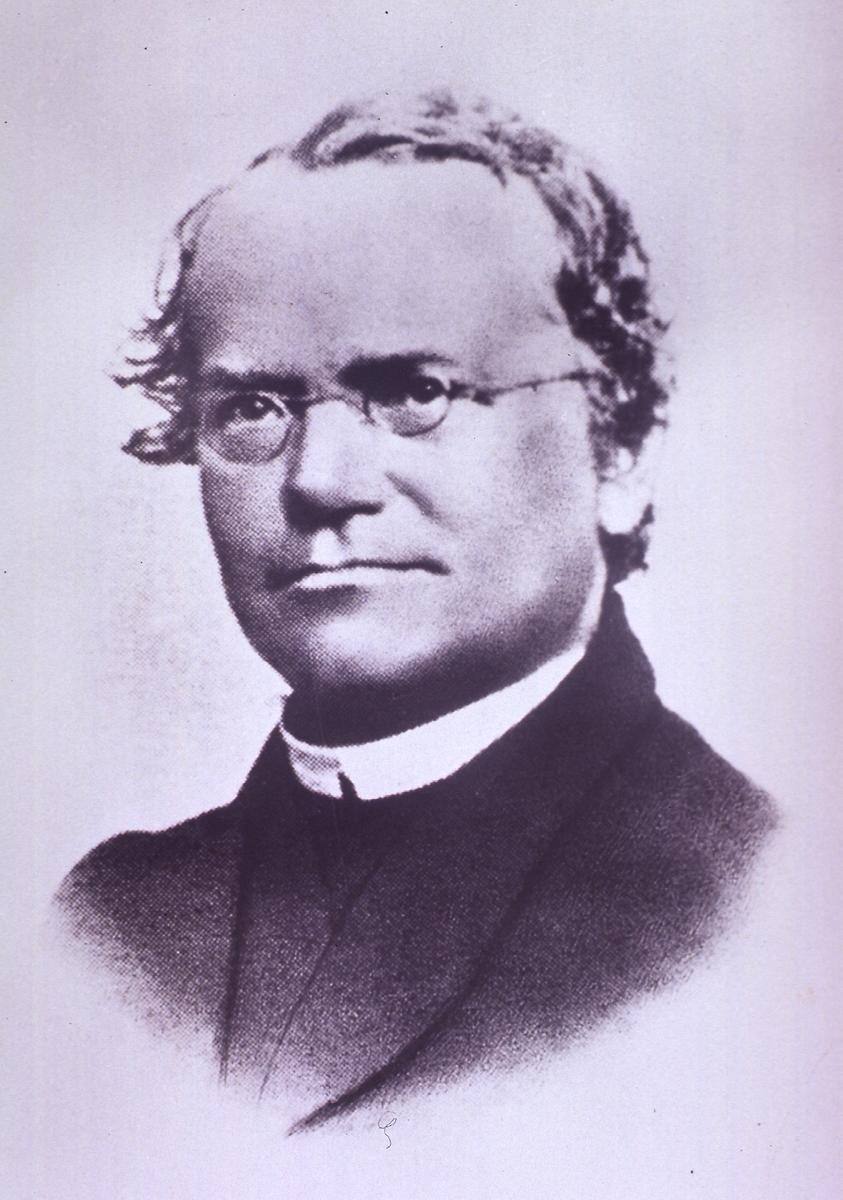
Gregor Mendel
Genetics is a branch of biology that studies heridity and variation in living organisms. Heredity is the passing of traits to offspring from its parent or ancestors.In the mid nineteenth centuary, an Austrailian monk named Gregor Mendel made several discoveries concerning genetics. The discoveries he made were so influencial that today he has been given the nickname, "the father of genetics." Mendel studied the inheritance of certain traits in pea plants and showed that the inheritance of these traits follows particular laws.
Mendel's Monohybrid Crosses Experiment:
Mendel began his experiment by choosing a specific type of plant that he was going to use during his experiment. He chose a garden pea plant because they are able to produce gametes, which are male and female sex cells. These two gametes are able to sexually reproduce through a process called fertilization. Fertilization is when the male gamete unites with the female gamete to form a zygote which in this case develops into a seed which later turns into a full grown plant. Mendel chose tall pea plants that were from populations of plants that had been tall for many generations and had always produced an offspring. He chose short pea plants that were from a population of short plants that had been short for many generations and had always pruduced an offspring as well. Mendel's method of choosing which tall plants and which short plants is known as true breeding. Now that his plants were selected, Mendel planned on crossing the two plants to create an offspring. Mendel referred to the offsping as hybrids. Hybrids are the different offspring of parents that have different forms of a trait, such as being tall or short. The tall plant and the short plant are the parents so they are kown as the P Generation.
F1 Generation:
-
Mendel selected a six foot tall pea plant and a pea plant that was less than two feet tall to cross first. He cross-pollinated the tall plant with pollen from a short plant and then planted the resulting seeds. The resulting plants of this generation were all tall as if the shorter plant had never exsisted.
F2 Generation:
- Next, Mendel let the tall plants in generation one self pollinate. After the seeds formed he planted them and found 1000 plants in generation two. He then found out that three-fourths of the offspring were as tall as the tall plants in the parent generation and one-fourth of the offsprnig were as short as the short plants in the parent generation. This makes a ration of 3:1.

Conclusions From the Monohybris Experiment:
Mendel concluded that each organim has two factors that control each of its traits. These factors are genes that are found in chromosomes. These genes exsist in alternate forms called alleles. Mendel also observed that when he crossed the tall and the short plants in the first generation, all the offspring were tall which means only one trait was observed. Mendel decided to call the observed trait the dominant trait and the disapeared trait the recessive trait. This means the allel for tall plants is dominant and the allel for short plants is recessive. Mendel's results from his experiment also gave him the inspiration to create the law of segregation. This law states that every individual has two alleles of each gene and when gametesare produced, each gamete revieves one of these alleles. When fertilization takes place, these gametes randomly pair up to produce four different combinations of alleles.
Phenotypes and Genotypes:
Two organisms can look alike but have different hidden allele combiinations. The way an organism looks and behaves is called a phenotype. The phenotype of a tall plant is tall, whether it is TT or Tt. The exact genetic makeup or the particular set of genes an organism has is known as its genotype. The genotype of a tall plant that has two alleles for tallness is TT. The genotype of a tall plant that has only one allele for being tall and one allele for being short is Tt. An organism's genotype can't always be known by its phenotype. An organism is homozygous for a trait if its two alleles for the trait are the same. The true breeding tall plant that had two alleles for being tall (TT) would be homozygous for the trait of height. On the other hand, an organism is heterozygous for a trait if its two alleles for the trait differ fromeach other. The tall plant that had one allele for being tall one one for being short (Tt) is heterozygous for the trait of being short.
Mendel's Dihybrid Crosses Experiment:
In Mendel's second experiment he used peas that were different from each other in two traits instead of one. This is known as a dihybrid cross because it involves looking at two traits in an organism. Mendel chose true breeding pea plants that had yellow seeds (RRYY) and crossed them with true breeding pea plants that had wrinkled green seeds (rryy).
F1 Generation:
When Mendel crossed the yellow seeds and the green wrinkled seeds, all the seeds in the first generation turned out to be round. This meant that the yellow seeds were the dominant allele and the green wrinkled seeds were the recessive allele.
F2 Generation:
Next Mendel let the F1 generation plants pollinate themselves. This time they produced four different types of plants. There were nine round yellow, three round green, three wrinkled yellow and one wrinkled green.

Conclusions From the Dihybrid Experiment:
Mendel's second law states that genes for different traits, such as shape and color, independently of each other. This law explains the results of the dihybrid and is known as the law of independant assortment.
Punnet Squares and Probability:
In 1905, an Englsh biologist named Reginald Punnett created a method of finding expected proportions of possible genotypes in the offspring of a cross. This method is called a Punett Square. In a Punnett Square the parents go on the side and the offsprings go in the center. If you know the geneotypes of the parents, you can use a Punnett Square to predict the possible genotypes of their offspring. A Punnet Square can be used to determine the probability of getting a pea plant that produces round seeds when two plants that are heterozygous are crossed. Probability is a way of expressing knowledge or belief that an event will occur or has occured. Probability can be written as a percentage or a ratio. Percentages express a number as a fraction out of 100 and ratios are expressions that compare quanities that are relative to each other. The likely hood of crossing will produce a particular type of offspring. A cross between organims with two different phenotypes produces offspring with a third phenotype in wihch both of the parent's traits appear together is known as co-domminance. When a cross between organisms with two different phenotypes produces offspring with a third phenotype that is a blending of the parental traits, incomplete dominance is taking place. Sex linked genes are the phenotypic expression on an allele that is related to the chromosomal sex of the individual. This type of inheritance is in contrast to the inheritance of traits on autosomal chromosomes where both sexes have the same probability of expressing the trait.
.png)
Diploid and Haploid Cells
A cell with two of each kind of chromosome is called a diploid cell. This pairing supports Mendel's conclusion that organisms have two alleles for each trait. One allele is located on both of the paired chromosomes. A haploid cell is a containing one of each kind of chromosome. Organims produce gametes that have one of each kind of chromosome. This supports Mendel's conclusion that parent organims give one allele for a trait to each of theit offspring. Every specie of organim has a characteristic number of chromosomes. The two chromosomes of each pair are called homologous chromosomes.
Meiosis
Meiosis is a type of cell division that produces gametes containing only half the number of chromosomes as a parent's body cell. It occurs in the specialized body cells of each parent that produces gametes. Meiosis consists of two seperate divisions known as meiosis I and meiosis II. Meiosis I begins with one diploid cell but by the end of meiosis II, there are four haploid cells. These zygote then develop into multicellular organisms through mitosis. This pattern of producing and and fusing haploid sex cells is known as sexual reproduction.
Meiosis I:

-
Interphase- the cell replicates its chromosomes. After replication, each chromosome has two identical sister chromatids held together by a centromere.
- Prophase I- the DNA of the chromosomes coils up and a spindle forms. As the DNA coils up a tetrad forms. Next crossing over takes place which is when non sister chromatids from homologous chromosomes break and exchange genetic material.
- Metaphase I- the centromere of each chromosome attaches to a spindle fiber. The spindle fibers pull the tetrads to the middle.
- Telophase I- the spindle breaks down, the chromosomes uncoil, and the cytoplasm divides to form two new cells. Each cell has half the genetic information as the original because it only has one chromosome from each homologous pair.
Meiosis II:

-
Prophase II- a spindle forms in each of the two new cells and the spindle fibers attach to the chromosomes.
-
Metaphase II- the chromosomes, that are still made up of sister chromatids, are pulled to the center of the cell and line up randomly.
-
Anaphase II- the centromeres of each chromosome splits, which allows the sister chromatids to seperate and move to opposite poles.
-
Telophase II- nuclei reform, the spindle fibers break down, and the cytoplasm divides.
Mitosis
Mitosis is a part of the cell cyle in which a cell centers its period of nuclear division. During this process, two daughter cells are formed each containing a complete set of chromosomes. Along with interphase, mitosis takes up a great portion of the cell cycle. Mitosis begins right after the G2 phase interphase.
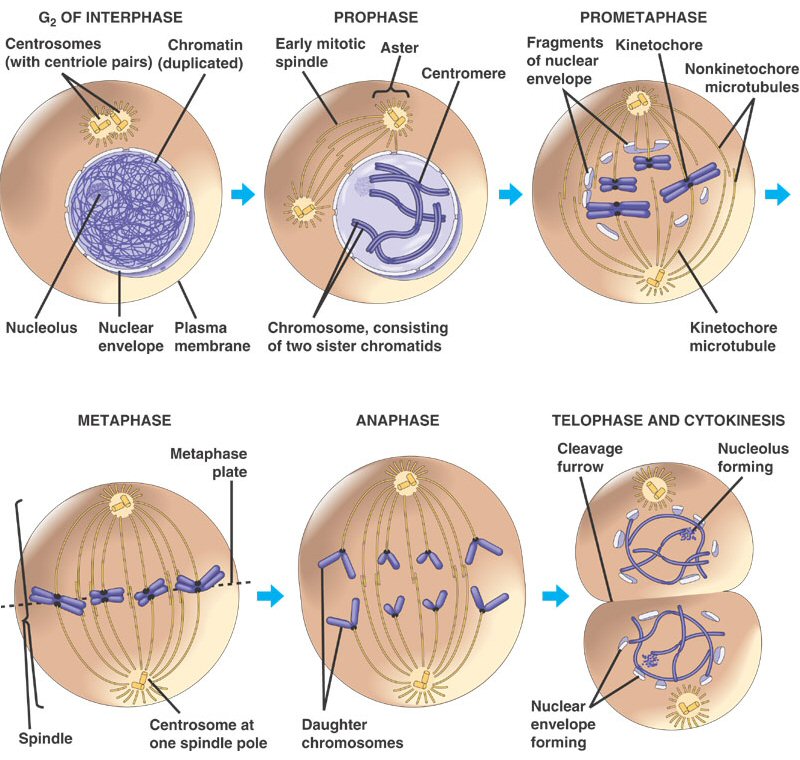
- Prophase- the chromatin coils to form visible chromosomes.
- Metaphase- the chromosomes move to the equator of the spindle.
- Anaphase- the centromeres split and the sister chromatids are pulled apart to opposite poles of the cell.
- Telophase- two distinct daughter cells are formed and the cells sperate as the cell cycle proceeds into cytokenisis.
