What is a Cell?
Cells are the basic unit of life. The cell is also the structural and functional unit of all known living organisms. It is the smallest unit of an organism that is classified as living, and is often called the building brick of life.The cell theory, created by Matthias Schleiden, states the following information about cells.
- All living thing are composed of cells.
- Cells are the basic units of structure and function in living things.
- New cells are produced from exsiting cells.
Types of Cells:
The two main types of cells are prokaryotes and eukaryotes. Prokaryotes are cells that do not contain a nuclei. They have genetic material that is not contained in a nucleus. They are usually smaller and simpler than eukaryotic cells, even though there are exceptions. Some prokaryotes have internal membranes as well. Even though prokaryotes are small, they are still able to carry out every activity associated with living things. They are able to grow, reproduce, respond to the enviroment, and some even have the ability to glide along surfaces of swin through liquids. Bacterias are prokaryotes. Eukaryotes are cells that containa nuclei. The genetic material of the cell is contained in the nucleus apaert from the rest of the cell. They are generally larger and more complex that prokaryotic cells. Eukaryotic cells contain dozens of structures and internal membranes that of which are mostly specialized. There is a very large variety of eukaryotic cells because there are unicellular ones and multicellular ones. Plants, fungi, and protists are eukaryotes. There are two types of eukaryotic cells which are plant and animal cells.
Parts of the Cell:
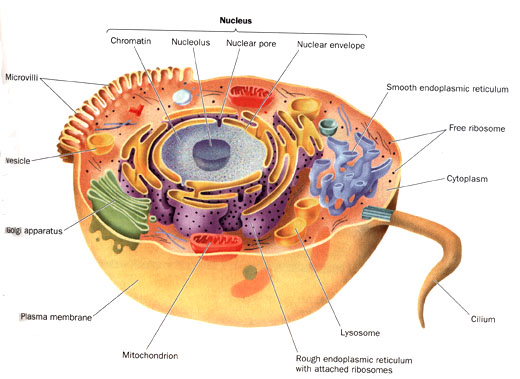
Cell Membrane: a thin, flexible barrier around the cell.
Cell Wall: a strong layer around the cell membrane.
Nucleus: referred to as the "control center" and it is a membrane enclosed organelle found in eurkaryotic cells. It contains most of the cells genetic material. It also controls most cell processes.
Cytoplasm: the material inside the cell membrane but not including the nucleus. It contains many of the protiens, molecules, and important substances that a cell needs.
Organelle: specialized organs within the cell.
Chromatin: an area where chromosomes and long strand of DNA are found. It is a granular material visible within the nucleus. It consists of DNA tightly coiled around proteins.
Chromosomes: thread like structures containing the genetic information that is passed from one generation of cells to the next.
Nucleolus: a small dense region within most nuclei in which the assembly of ribosomes begins. It basically helps to produce more ribosomes within the cell.
Nuclear Envelope: a double membrane that surrounds the outside of the nucleus. It regulate what stays and what leaves the nucleus.
Cytoskeleton: it supports the structure of the cell and gives the cell shape.
Microtublues: hallow tubes of protein that maintain cell shape and can alsoserve as a "track" along which organelles are moved.
Mitochondria: a cell organelle that is called "the cellular power plant" because it genereates most of the cells supply of adenosine triphosphate(ATP), used as a source of the chemical. It releases ebergy stored from food mlecules too.
Centrioles: barel shaped organelle that are found in most eukaryotic cells. Centrioles line up th chromosomes inside the cell and then pull the chromosomes apart during cell replication. It also produces th cell's cytoskeleton.
Ribosome: small particles in the cell on which proteins are assembled. They are made up of RNA and protein.
Rough Endoplasmic Reticulum: is studded with protein manufacturing rbosomes giving it a rough appearence. It is an intrconnected network of tubules within cells which houses some of the ribosomes.
Smooth Endoplasmic Reticulum: an internal membrane system in cells in which components of the cell membrane are assembled and some are modified.
Golgi Apparatus: a cell structure used for processing and storing the proteins synthesized in the endoplasmic reticulum. Some end up as proteins embeded in the plasma membrane while other proteins moving through the Golgi Apparatuswill end up in lysosomes. It is also a stack of membranes in the cell which enzymes attach carbohydrates and lipids to proteins.
Vesicle: are mainly involved in the transortation of material in and out of the cell. They transport proteins from the rough endoplasmic reticulum to the Golgi Apparatus. Some vesicles serve as storage vessels.
Lysosome: a cell organelle filled with digestive enzymes. They are needed to break down food or othercertain materials in the cell. This makes the food or other certain materials way easier to digest.
Vacuole: a cell organelle that isolates materials that might be harmful to the cell. It contains waste products, and it also helps to maintain internal pressure or turgor within the cell. It contains water, salt, proteins, and carbohydrates.
Transport in and Out of Cells:
The cell membrane regulates what enters and leaves the cell and it provides protection and support for the cell. Most cell membranes are made up of a double-layered sheet called a lipid bilayer. The lipid bilyer provides the cell membrane with a flexible structure that forms a strong barrier between the cell and its surroundings. Also, most lipid bilayers contain protein molecules that have carbohydrates attached to them. The cell membrane decides what enters and leaves the cell by usuing transportation methods such as diffusion, osmosis, and active transport.

Diffusion:
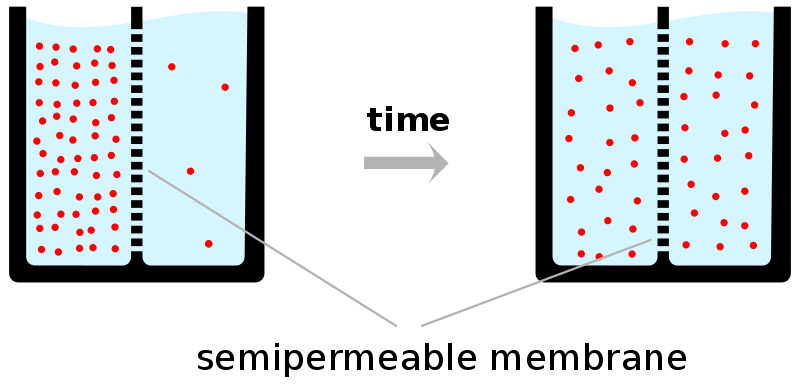
Diffusion is the process when particls in a solution tend to move from an area of high concentration to an area of low concentration. When the concentration of the solute is the same all through a system, the system has reached its equilibrium. If a substance is in an area of unequal concentration on either side of the membrane and the substance crosses the cell membrane, its particles will move to a lower concentration area until it reaches its equilibrium. Once that happens, the concentration levels on both sides of the membrane will be the same. Diffusion is able to happen without using the cells energy.
Osmosis:
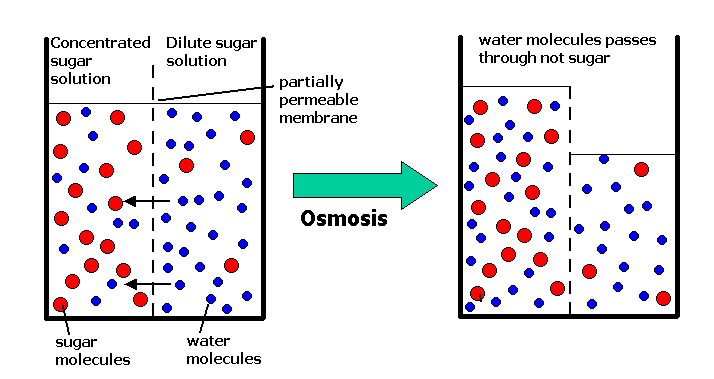
Osmosis is the diffusion of water through a selectively permeable membrane. When there are more sugar molecules on one side of the membrane than the other, this means the concentration of water on the opposite side is lower than on the other side. This means the solution is hypertonic or above strength. The membrane is permeable to water but not to sugar. This means water can crossthe mebrane in both directions but sugar can't. Thus the water is moving from an area of high soncentration to an area of low concentration. Water tends to move across the membrane until equilibrium is reached. When this happens the concentrations of water and sugar will be the same on both sides of the membrane. At this point, the two solutions are now isotonic, or of same strenth. The dilute solution was hypotonic or below strength.
Active Transport:
Active transport is the movement of particles from an area of high concentration to an area of low concentration. Active transport requires energy because like climbing the stairs, it takes more energy to go from top to bottom than to go from bottom to top. The transport of smaller molecules or ions across a cell membrane is carried out by pumps or transport proteins found in the membrane. The transport of larger molecules across a cell membrane is transported by endocytosis and exocytosis. Transporting larger molecules can sometimes involve changing the shape of the cell membrane. Endocytosis is the process of taking material into the cell by using infoldings, also known as pockets, of the cell membrane. Phagocytosis is when extensions of the cytoplasm suround a particle and package it within a food vacoule before it is then engulfed. In pinocytosis the cell takes up liquid from the surrounding enviroment, tiny pockets form along the cell membrane and fill wiht liquid, and then the pockets pinch off to form vacuoles within the cell. And in exocytosis, the membrane of the vacoule surrounding the material joins with the cell membrane and forces out the contents of the cell.

Special Cells and Organizing Cells:
Cells inside an organism can develop in numerous ways to perform different tasks. This processs is known as cell specialization. For example, cells in multicellular organisms are specialized to form particular functions within that organism. Unicellular organims have special cells as well which unclude volvox aureus, leptospira interrogans, and yeasts. Some of these special cells include red blood cells, pancreatic cells, muscle cells, and stromata cells. These special cells are able to form much bigger things when they group together. In multicellular organisms the levels of organization are indivdual cells, tissues, organs, and organ systems. A tissue is a group of similar cells, and there are four main types. They are muscle, epithlial, nervous, and connective tissue. Organs are groups of tissue that work together. Each piece of tissue in an organ plays an important role in the overall function of the organ. Finally, a group of organs that work together is known as an organ system. Examples of organ systems include the digestive system, the skeletal system, the respiratory system, and the nervous system. Organizing the body's cells into tissues, organs, and organ systems divides the labor among cells helps to make a cells life possible.

