What is Organic Chemistry?
Organic cheimistry is a branch of chemistry dedicated to the study of the structures, creations, and reactions of carbon-containing compounds. It involves learning about the functions of atoms, the results of bonding, and the creation of new compounds and molecules. Before studing the more complicated sections of chemistry, it is good to be familiar with basic knowledge involving chemistry.
Atoms Atoms are the building blocks of all matter and the smallest particle of an element. All atoms contain electrons, protons, neutrons, quarks, and a nucleus. Electron- subatomic particle located outside of the nucleus in an area known as the electron cloud. Itis negatively charged and it does not add to the atomic mass. Proton- subatomic particle located within the nucleus of the atom. It has a positive charge and it is used to determine the name of the atom. It adds to the atomic mass as well as the atomic number. Neutron- subatomic particle locatd within the nucleus. It has no charge but it still adds to the atomic mass. Nucleus- the center of an atom and a dense area containing protons and neutrons. Electron Cloud- the area surrounding the nucleus and the most likely place to find electrons.
|
|
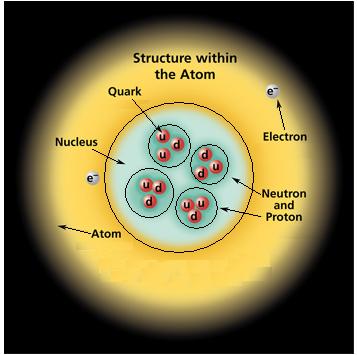
Quarks- subparticles found in the nucleus. Just like an atom is composed of a nucleus and electrons, a nucleus is composed of quarks. Quarks come in three flavors which are red, blue, and green. They also have two directions which are up and down. The combination of these will give you different particles such as neutrons or protons. For example, two ups and a down make up a proton.
First Models of the Atom
-
The first model of the atom was presented by a man named John Dalton. His model of the atom later became known as the "ball bearing model". Dalton's model was based off of his atomic theory. Although his theory was flawed, it was very influencial because it set up the building blocks for scientists to come. Dalton's model of an atom was a small, solid and indivisible particle.
-
The second model of the atom was created by a scientists named JJ Thomson. After conducting several experiments, Thomson's results showed that: 1) atoms are divisible, and 2) they include negatively charged electrons. Thomson's "plum-pudding model" of the atom has negative particles spread evenly through out a solid, positively charged sphere.
-
The third and currently used model of the atom was created by Ernest Rutherford. After conducting the Gold-Foil experiment, Rutherford concludes that there must be a very small and densly packed region of positive charge in the atom. In addition to that, this region has the ability to repel these alpha particles. As a result of his discovery Rutherford was given a large amount of credit for discovering the nucleus.

The Periodic Table of the Elements
The periodic table of the elements is a graphical chart of elements arranged by similar properties and structures. It is usedto provide information on the elements found on the table. It also displays the number of protons, neutrons, electrons,and valence electrons each element has. Information such as atomic number, atomic weight, reactivity, conductivity is displayed on the table as well. The periodic table of the elements is used to classify elements,compare different forms of chemical behavior, and to identify which elements will bond with each other. By discovering which elements will bond with each other, scientists are able to predict information such as which elements will form compounds with unique properties. One of the most important things that the periodic table shows is the number of valence electrons. The number of valence electrons is key to learning about bonding, which leads to the creation of molecules and compunds.

The Periodic Table and Bonding Since the periodic table tells us so much information about all of the different elements, it makes it much easier to leanr about bonding. Atoms bond because they are unstable or unbalanced. To beceom stable or balanced an atom must have a total of eight valence electrons in its outermost shell. Basically, everything wants to be more stable through the formation of bonds. There are different types of bonding that are used. These are Ionic bonds, metallic bonds, and covalent bonds. Ionic Bonds- take place between a metal and a nonmetal. During ionic bonding electrons are taken to fill outer orbits. At room temperature they are solids with high melting and boiling points. In a solid state they are poor conductors of electricity. They form strong bonds because the ions are attracted to ions of opposire charge in all directions forming a lattice. Metallic Bonds- take place between two metals. They are solids at room temperature and they are malleable. They also conduct heat and electricity very well. Covalent Bonds- take place betwen two nonmetals. They are usedin forming organic molecules and during covalent bonding electrons are shared. At room temperature they are gases or liquids. | 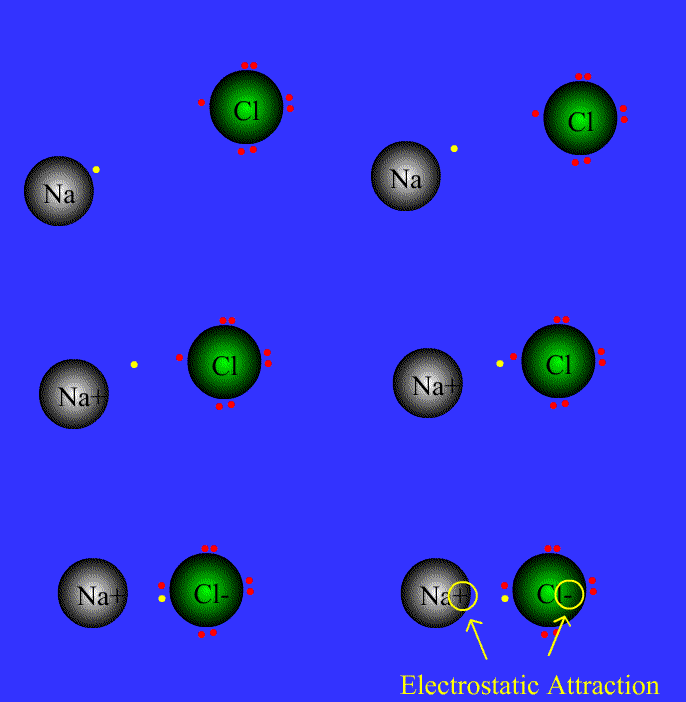 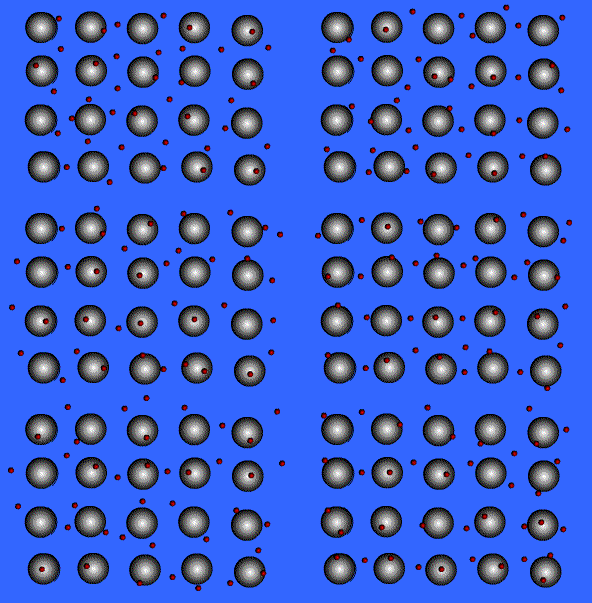 |
Inorganic Molecules
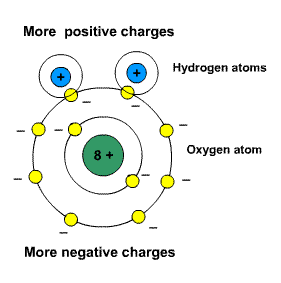
Inorganic molecules are substances that don't have carbon-hydrogen bonds. They are usually much simplier and they are typically not found in living things. Inorganic molecules include things such as minerals, metals, and salts. A good example of an inorganic molecule is water. Most organisms rely on inorganic molecules to function correctly and live healthy lives. Some molecules contain carbon and are still inorganic. For instance, a diamond is made up of carbon atoms yet inorganic, basically because of the early notion that an organic molecule is derived or produced by living organism, and diamond is a mineral and not of biological origin.
Organic Molecules
Organic molecules are substances that contain carbo-hydrogen bonds. They are usually found in living things. The major classes of organic molecules are carbohydrates, proteins, lipids, and nucleic acids.
Carbohydrates are rings of carbon and there are two main types found in food called simple and complex. Simple carbohydrates are mom-saccharides and dissacharides. Examples of these are found in sugar bowls, lollipops, fruits, and milk. Complex carbohydrates are polysaccharides such as the ones found in starches like grains, bread pasta, and rice.
Proteins look like long chains. These chains are called polypeptides and they are made up of amino acids. Amino acids are the basic structural building units of proteins. They form short polymer chains called peptides or longer chains called polypeptides or proteins.
Lipids are hydrophobic or in other words, they repel or wo'nt mix with water. This includes fats, oils, waxes, phospholipids (cell membranes) and steroids (like cholestoral). Fats and oils are made up of two kinds of molecules: glycerol and three fatty acids joined by dehydration synthesis. The three fatty acids attached are known as trigylcerides.
Nucleic acids look like a ladder. They are macromolecules and they are composed of chains of nucleotides. They form structures within cells and they are found in all living things because they are found in cells. Common types of nucleic acids include deoxyribonucleic acid (DNA) and ribonucleic acid (RNA).
Carbon Bonds
The reason why organic molecules are organic is because they have carbon bonds. Since carbon has four bonds it can bond with either itself or with other molecules to become stable or balanced. Carbon is the building block for almost all of the other elements. Carbon is able to form single, double and triple bonds with numerous other atoms. When carbon bonds with hydrogen it forms hydrocarbons which can be saturated or unsaturated. Satrurated hydrocarbons are formed using only single bonds and unsaturated hydrocarbons are used with double or triple bonds.


